4 0 2

402 days. 402 (plus or minus… mostly minus) posts.

Category: Philosophy

Day 104: Weekend Watching

Sir Ken Robinson is a creativity expert, an author and an international advisor on arts and education. While you’re juggling ballet classes, naps, farmer’s markets, shows, errands and absolutely nothing this weekend, get comfy in your favorite chair and watch his presentations from the 2006 and 2010 TED Talks. You’ll be so glad you did.

He makes a compelling and humorous case for an education revolution—a new way of thinking about learning that exposes and nurtures children’s natural talents, rather than squishing them into linear and not terribly creative systems.

Without innovative children, we will lack innovative adults. And without innovative adults, our species is sort of screwed.

TED 2006: Do schools kill creativity? 

“We have to rethink the fundamental principles on which we’re educating our children. There was a wonderful quote by Jonas Salk, who said, ‘If all the insects were to disappear from the earth, within 50 years all life on earth would end. If all human beings disappeared from the earth, within 50 years all forms of life would flourish.’ And he’s right.”


TED 2010: Bring on the learning revolution!

“…education, in a way, dislocates very many people from their natural talents. And human resources are like natural resources; they’re often buried deep, you have to go looking for them, they’re not just lying around on the surface. You have to create the circumstances where they show themselves.”
Day 103: Vocal Repetition

There’s just something about vocal repetition—saying something over and over again until the meaning changes form; until the words morph into something else and unfamiliar, and then become physicalized.

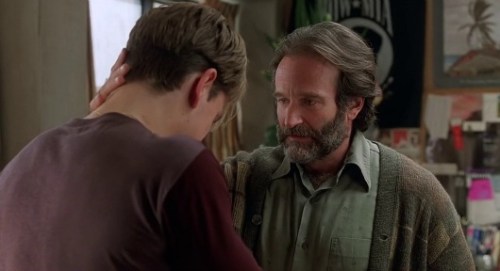
Remember Good Will Hunting? When Sean (Robin Williams) tells Will (Matt Damon) that his past isn’t his fault? Sean pointedly repeats, “It’s not your fault,” over and over until Will breaks down into tears and grasps Sean in a tight hug.

The actual language is more powerful than the sound in this case, but it’s still a good example of a physical reaction.

If you don’t know what I’m talking about, you should probably Netflix Good Will Hunting. Or watch the “It’s not your fault” clip.

good-will-hunting-its-not-your-fault

In my yoga class this evening, we repetitively OM-ed. We chanted ahhhhh-ooooooooh-mmmmm, over and over and over.

I spent the first few rounds wincing and feeling sorry for the pour souls who couldn’t hear themselves OM-ing so wretchedly off-key. Then, I wondered if I was the poor soul so wretchedly off-key, because it was kind of hard to tell. And then five or six OMs in, our class perfectly hit the pitch of the opening theme song to Battlestar Galactica (it was seriously dead-on) and I got the OM-ing giggles.

For the next few OMs, I tried to settle down and get serious. My “ahhhh”s sounded suspiciously like “ahh-hah-hah”s, and I  really wanted to invest in the experience instead of picturing Caprica City and sleek cylon fighters.

Eventually—and I’m not sure exactly when—all my wincing, giggling and cylon fighter-picturing faded away. I became enveloped in the sound of OM and experienced it in my body instead of in my head. I felt the sound vibrate around my skin, inside my skull, in my chest and my throat, and through my pressed-together hands. For lack of a more articulate way to say it, it was really cool.

When our instructor gently interrupted us, I had no clear concept of how long we’d been OM-ing and had to climb my way back to the surface to open my eyes and begin moving.

Although we don’t often think about it (let alone remember to experience it), sound is physical. In order to make noise, the tiniest vibrations of our vocal chords reverberate inside and outside of us. Weeding through the discomfort to actually experience the sounds we make is a very worthwhile endeavor. I’m sure Sean and Will would agree.

Day 102: Banishing the R-word

Language is a powerful, powerful part of human life. When strung together, words can create peace between countries, start wars, feed eager minds with beautiful new worlds and ideas, heal wounds, damage hearts and build incredible connections.

For how effective and intense it is, we treat language surprisingly recklessly. Sometimes we fling words around like they don’t even matter, as though they float (or fly) out of our mouths, break apart and then disappear into the air. On the contrary, our words slip into our recipients’ ears and make the neural network rounds, eventually becoming part of each person’s very make-up.

As an aside, this phenomenon is even more apparent in the Twitterverse, where Tweeters tend to forget that every 140-character burp is preserved online, no matter how mean or mundane (I admittedly  fall into the mundane category, but I vow to never, ever be mean).

In acknowledgment of language’s power, I love this campaign to end the R-word (“retard/ed”). Today is R-word awareness day, and I’m pledging to not say it. I hope you’ll take the pledge, too.

Here’s what R-word.org says about why it should be banished:

The R-word hurts because it is exclusive. It’s offensive. It’s derogatory.

Our campaign asks people to pledge to stop saying the R-word as a starting point toward creating more accepting attitudes and communities for all people.  Language affects attitudes and attitudes affect actions.  Pledge today to use respectful, people-first language.

Let’s do it. 

Day 100: Borrowed from Bertrand

To celebrate 100 days of blogging, I’m taking a little blogging break tonight to figure out my taxes (Step 1. Look at pile of receipts. Step 2. Watch The Bachelor. Step 3. Look at pile of receipts again.). It’s going to be a long night.

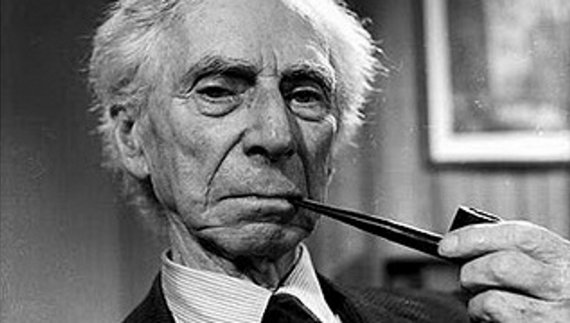
While I shuffle paper and create the same spreadsheet five times over, I’m borrowing some content from philosopher, mathematician, historian and social critic Bertrand Russell.

Bertrand Russell

These are his 10 Commandments of Teaching. I love them and originally found them on my absolute favorite blog, Brain Pickings.

From Mr. Russell:

Perhaps the essence of the Liberal outlook could be summed up in a new decalogue, not intended to replace the old one but only to supplement it. The Ten Commandments that, as a teacher, I should wish to promulgate, might be set forth as follows:

  1. Do not feel absolutely certain of anything.
  2. Do not think it worth while to proceed by concealing evidence, for the evidence is sure to come to light.
  3. Never try to discourage thinking for you are sure to succeed.
  4. When you meet with opposition, even if it should be from your husband or your children, endeavor to overcome it by argument and not by authority, for a victory dependent upon authority is unreal and illusory.
  5. Have no respect for the authority of others, for there are always contrary authorities to be found.
  6. Do not use power to suppress opinions you think pernicious, for if you do the opinions will suppress you.
  7. Do not fear to be eccentric in opinion, for every opinion now accepted was once eccentric.
  8. Find more pleasure in intelligent dissent than in passive agreement, for, if you value intelligence as you should, the former implies a deeper agreement than the latter.
  9. Be scrupulously truthful, even if the truth is inconvenient, for it is more inconvenient when you try to conceal it.
  10. Do not feel envious of the happiness of those who live in a fool’s paradise, for only a fool will think that it is happiness.

Day 99: Dance Rights

A little over a year ago, German choreographer Anna Teresa De Keersmaeker told a Danish blog that she had not been asked permission for her choreography to appear in Beyonce’s new Countdown video. The controversy unearthed a great discussion about dance art and who owns the rights to it. Once a movement is out in the world, can anyone use it, reframe it and call it their own? What if the original costumes and setting are used for “inspiration” as well? How far is too far?

Dance is a little harder to pin down than music, which has more rules and regulations about what constitutes plagiarism.

Whether Beyonce’s choreography team was right to appropriate the work or not, I’d like to share the video of the works side by side. At the very least, I think it’s wonderful to see brilliant modern dance make its way through pop culture channels.